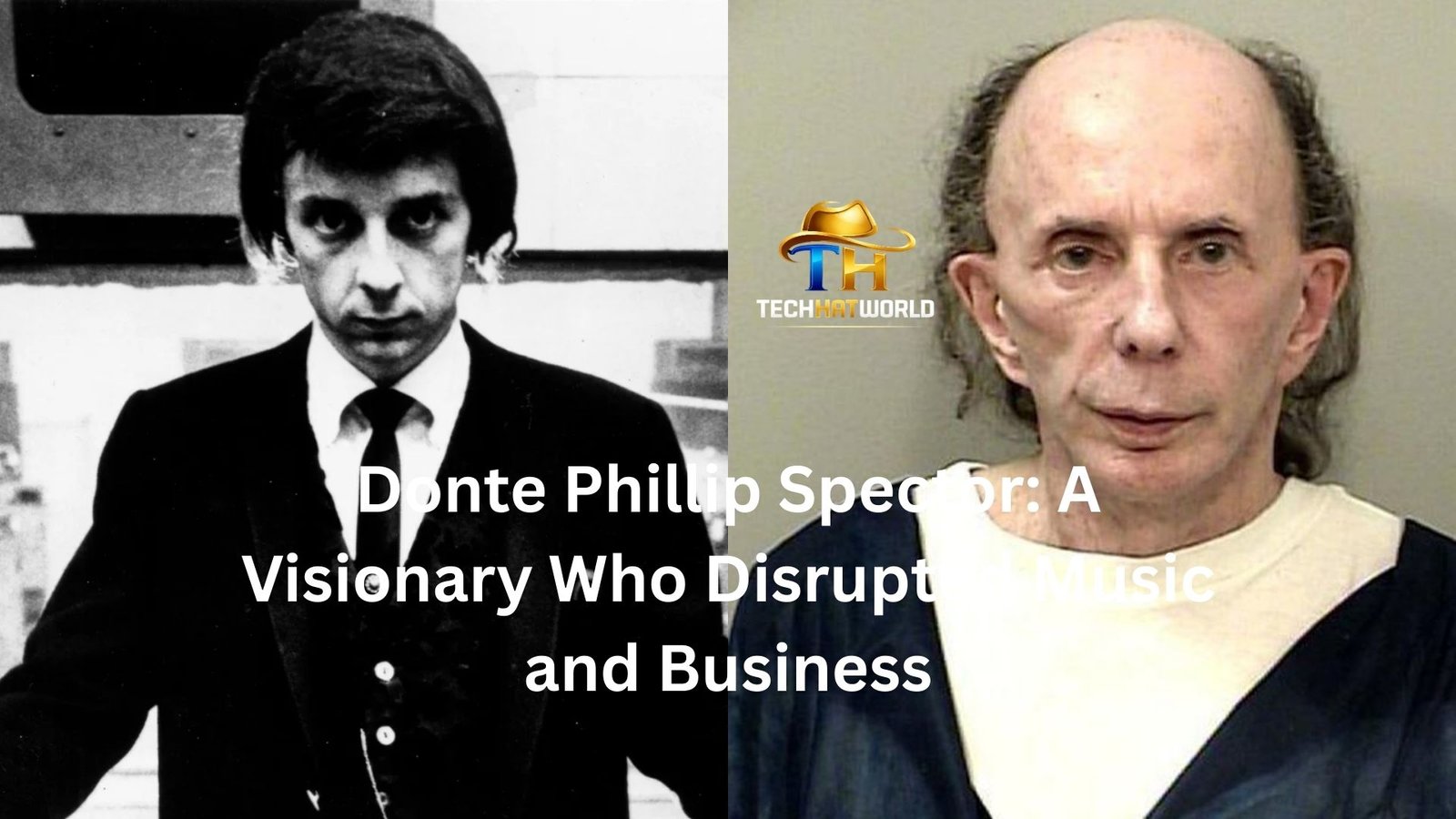
If you’ve ever heard the term “Wall of Sound,” you’ve encountered Donte Phillip Spector’s legacy, whether you know it or not. The name might not always ring bells, but the impact of his work resonates through decades of music. Spector was one of the most influential, yet controversial figures in the history of music production. His distinct style not only changed how records were made, but also altered the landscape of pop culture itself.
In the 1960s, when music was evolving rapidly, Spector was one of the driving forces behind that evolution. But while he was being hailed as a genius, he was also often considered a madman in the studio. He demanded total control, a tight grip on every note, every beat, and in some cases, he drove people to the brink of frustration. Spector’s methods were eccentric, to say the least, but the results were undeniable. Let’s dive into the life of Donte Phillip Spector, a man who left a mark on music that’s still felt today.
Early Life and the Genesis of a Visionary
Born in 1939 in the Bronx, New York, Spector’s early life was marked by tragedy. His father committed suicide when Spector was just nine years old. This dark event would shape much of his personality and drive, influencing both his personal life and professional career. Spector’s love for music started early, and by his teens, he was already infatuated with the sounds of rock and roll, jazz, and rhythm & blues. But it wasn’t just the music that caught his attention—it was the power of production, the ability to shape the sound into something larger than life.
Spector moved to Los Angeles, and that’s where his career truly took off. He first worked as a session musician before gaining attention as a producer. In 1961, he formed his own record label, Philles Records, and his infamous “Wall of Sound” was born. It wasn’t just a production technique; it was a philosophy. Spector wanted his music to sound big—epic, even—and he used an orchestra of instruments, dense arrangements, and layers of sound to achieve that goal.
But here’s the thing: Spector wasn’t just about making music sound massive; he was about capturing emotion in every note. It’s almost like he believed that the recording process itself should reflect the intensity of human experience. When you listen to some of his greatest productions, like The Ronettes’ Be My Baby, or The Righteous Brothers’ You’ve Lost That Lovin’ Feelin’, it’s like you’re being hit by a wave of sound—overwhelming and exhilarating.
The ‘Wall of Sound’: More Than Just a Technique
The term “Wall of Sound” has become synonymous with Spector, and for good reason. What made it so revolutionary wasn’t just the volume or the complexity—it was the emotional depth that Spector managed to create. In the mid-’60s, Spector began experimenting with dense orchestral arrangements. He brought in musicians who usually played in classical settings and mixed them with rock instrumentation. The result was something completely new: a layered, almost orchestral sound that enveloped the listener, making even the simplest pop song feel monumental.
Spector’s approach to recording was intense. He would often insist that musicians record their parts multiple times, layering them until the track was so full that you could barely pick out individual elements. He would add vocal harmonies, strings, percussion, and sometimes even more obscure instruments, all creating a rich and immersive atmosphere.
Consider the first time someone heard Be My Baby. It’s a pop song, yes, but it feels almost cinematic. The beat, the echoing drums, the lush strings—it was so far removed from the sparse sounds that had dominated pop music up until then. It was music that didn’t just fill the speakers; it consumed the room. And that’s what made Spector’s productions so powerful—they didn’t just play on your ears, they played on your emotions.
The Fame, The Genius, The Madness
By the mid-’60s, Donte Phillip Spector was a household name in the music industry. He had worked with some of the biggest acts of the time, from The Crystals to The Righteous Brothers to the Beatles. But as much as he was revered for his talent, his eccentricities were just as well-known. Spector was not your average music producer. He wasn’t the type to sit quietly behind a mixing board and let the artists do their thing. He was known for his perfectionism, for pushing musicians to the edge, for demanding absolute control over every aspect of the music.
He had an almost obsessive need for total power in the studio. There are stories of him locking himself in his office for hours during sessions, refusing to interact with the band until the perfect take was achieved. Spector wasn’t afraid to alienate people—he often did—but the results spoke for themselves. His vision, though sometimes frustrating, was also incredibly effective.
But his personal life started to mirror the chaos in the studio. While he was riding high on his success, rumors of erratic behavior, mood swings, and dangerous tendencies began to emerge. His obsession with control extended beyond the music business and into his personal life. This created an unsettling contrast with the genius that was so apparent in his work. Spector, for all his brilliance, wasn’t exactly an easy person to work with. In fact, some of his collaborators would later speak about how draining it was to be around him. But at the same time, they couldn’t deny the magic he brought to the music.
The Fall and the Legacy
As the years went on, Spector’s influence began to fade. The ’70s saw the rise of new musical movements that were at odds with Spector’s heavy-handed approach. His last major hit came in the early ’70s when he worked on Let It Be with The Beatles. But even then, his contributions were both celebrated and criticized—his exact role on that album remains a subject of debate to this day.
But what about the man himself? By the 1980s, Spector had become more reclusive. He had been involved in several legal and personal issues, including accusations of violence. His life became marked by scandal, and his career seemed to be in freefall. However, despite his personal troubles, the “Wall of Sound” remained relevant. Music producers and artists who grew up with his work continued to cite Spector as an influence.
In the end, Spector’s personal downfall was as tragic as his rise was meteoric. In 2009, he was convicted of second-degree murder for the death of actress Lana Clarkson. The story of his life, like his music, is full of contradictions. A genius who shaped music, yes—but also a man who couldn’t escape his own demons.
Donte Phillip Spector’s Impact: A Lasting Influence
Here’s the thing: Donte Phillip Spector’s contribution to music isn’t just in the records he produced, but in how he redefined the role of the producer. Before Spector, producers were often faceless figures—people who helped with technical aspects of recording. But Spector made producers celebrities in their own right. He showed that production could be an art form, just as much as songwriting or performing.
Even today, his influence is still felt. Modern producers like Phil Collins, Mark Ronson, and even Kanye West have cited Spector as an inspiration. The “Wall of Sound” may not be used in the same way today, but its emotional intensity still informs how music is made. The idea of layering tracks to create something that transcends individual sounds—that’s something every music producer has to keep in mind.
Spector’s genius was in his ability to capture the emotional core of music. It wasn’t enough to have a catchy melody or a tight beat; he wanted to make music that could break your heart or lift you up in an instant. His productions had weight—they had depth. And that’s why, despite his controversial and tragic life, his legacy as a producer is undeniable.
A Final Word
Donte Phillip Spector’s story is a reminder that genius often comes with a price. The man who changed music forever also found himself trapped in the very chaos he created. Yet, as the years go by, it becomes increasingly clear that his influence is still shaping the sound of modern music. While his life was messy, his artistry will continue to inspire for generations to come.